
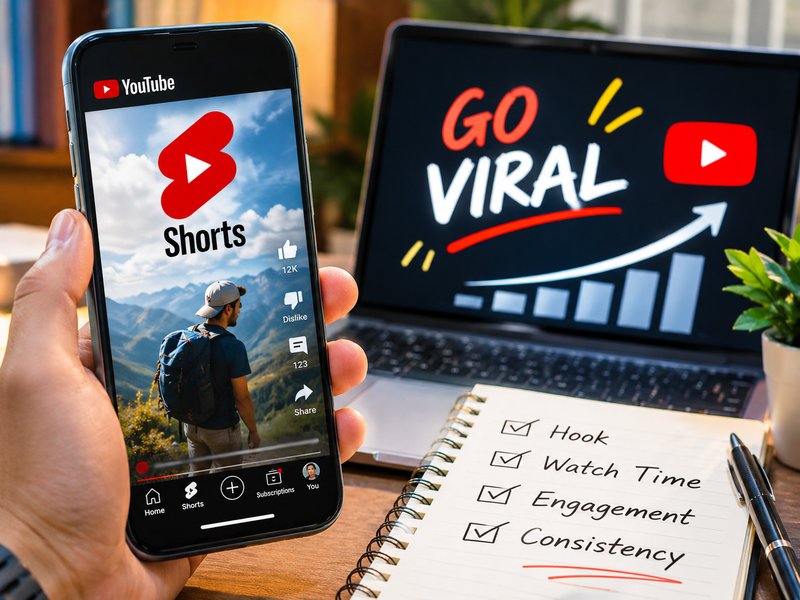
To go viral on YouTube Shorts, hook viewers in the first second, keep them watching to the end, and post consistently on a clear topic. The algorithm rewards Shorts that people choose to watch rather than swipe past. There is no secret trick. Beginners win by improving their hook, pacing and consistency, one Short at a time.
What does “going viral” actually mean on Shorts?
Viral is relative. A viral Short is usually one that significantly outperforms your channel average: if your Shorts normally get 1,000 views, 50,000 is effectively viral for you. Niche matters too, since a vintage car restoration Short might need far fewer views than a dance video to count as a hit. Set your target against your own baseline, not against huge creators.
How the YouTube Shorts algorithm works
Shorts are served in a swipe feed. YouTube shows a new Short to a small test audience first. If that group engages well, the Short is promoted to a broader audience; if they don’t, views stall.
The most important idea to learn is engaged views. Since March 31, 2025, a Short’s public view count includes every start or replay with no minimum watch time, and the older method was renamed “engaged views.” Only engaged views count toward Partner Program eligibility and revenue payouts. So the public number can look better than your real performance.
The metric to watch is Viewed vs. Swiped Away. It tells you how many people stayed versus scrolled past. You can find it in YouTube Studio under Analytics (Advanced mode).
Step-by-step: how to go viral on YouTube Shorts as a beginner
1. Pick one niche and one audience
Channels that cover one topic give the algorithm a clearer signal about who should see them. Start with a topic you can make 30 videos about.
2. Build your hook in the first second
Your opening decides whether people swipe. Start mid-action, state the payoff (“This one setting doubled my battery life”), or show the surprising result first. Skip logos and long intros.
3. Design every frame like a thumbnail
Use big, readable text, high contrast and a clear subject. Many viewers decide in an instant.
4. Keep retention high
Cut pauses, change the visual every few seconds, and remove anything that doesn’t move the story forward. One creator guide suggests that shorter Shorts need near-complete average viewing, while longer ones can get by with less. Treat that as a rule of thumb, not an official YouTube figure.
5. Choose the right length
Advice varies widely. Shorts can now run up to three minutes, but length alone has little to do with whether a Short goes viral. Different sources suggest sweet spots anywhere from 15-40 seconds to 50-60 seconds. A sensible beginner approach: make each Short exactly as long as the idea needs, then compare your own results.
6. Make loops and rewatches possible
End in a way that flows back into the start, or add a detail viewers might miss the first time.
7. Use search, not just trends
Trending sounds help, but search-friendly topics keep earning views for months. Put your main keyword in the title, spoken script and on-screen text.
8. Write a clear title and description
Keep titles short and specific. Add a few relevant hashtags and a line of context in the description.
9. Post consistently
One guide recommends posting 3-5 Shorts per week to train the algorithm to distribute your content. That is a common creator recommendation, not an official rule. Pick a schedule you can actually keep.
10. Review your analytics and repeat what works
After each batch of 5-10 Shorts, check which ones had the best Swiped Away rate and engagement. Make more like those and fewer like the rest.
Common beginner mistakes
- Chasing total views only. Look at engaged views and retention.
- Slow openings. If nothing happens in the first second, viewers leave.
- Jumping between topics. It confuses both the algorithm and your audience.
- Reposting with watermarks from other apps. Export clean files instead.
- Quitting after 5 videos. Most channels need dozens of uploads to find what works.
Free tools to get started
You can shoot and edit on your phone. For editing, see our guide to the best free apps for editing Reels, since the same apps export vertical video that works on Shorts. If you want deeper detail on ranking, read our YouTube Shorts algorithm explainer.
Final thoughts
Going viral on Shorts comes down to three things: a hook that earns the first second, pacing that earns the last, and enough uploads to learn what your audience likes. Start with one niche, post consistently, check your Viewed vs. Swiped Away rate, and improve each video a little.
Frequently Asked Questions
There is no official number. Many creators call 100,000+ viral, but it depends on your niche and channel size. Compare against your own average.
Up to three minutes is allowed, but there is no single best length. Match the length to your idea and keep viewers watching to the end.
They count views where the viewer stays beyond the first moments or interacts. They matter more than raw views for the algorithm, Partner Program eligibility and earnings.
Consistency matters more than any exact number. Many creators aim for 3-5 per week.
Yes. Shorts are shown to new viewers based on how people respond, not mainly on how large your channel is, which is why small channels can break out.
They can help with topic context, but a strong hook and retention matter far more. Use a few relevant ones, not a long list.